

The future of AI and robotics is less robots replacing humans and more robots becoming our wildly efficient coworkers who never steal lunch from the fridge.
AI will grow more adaptive, contextual, and human-aware—moving beyond narrow tasks to systems that can reason, collaborate, and personalize decisions in real time. Think AI that understands nuance, ethics, and long-term consequences rather than just crunching data fast.
Robotics, powered by that intelligence, will become more dexterous, mobile, and socially aware. Robots will increasingly operate outside factories—assisting in healthcare, elder care, disaster response, construction, logistics, and even creative fields. They’ll be safer around humans, better at learning from observation, and capable of working in unpredictable environments.
Together, AI and robotics will reshape daily life:
- Healthcare: surgical robots, AI caregivers, and smart rehabilitation
- Work & industry: collaborative robots (“cobots”) boosting productivity
- Homes & cities: service robots, autonomous transport, smart infrastructure
- Human potential: freeing people from repetitive labor so creativity and strategy take center stage
In short: the future isn’t a robot uprising—it’s a quiet takeover of the boring stuff, while humans do more of what makes us human. And yes, robots may still struggle with stairs. For a while.

on October 9, 2026 at 1:40 pm
Humans can move their limbs very rapidly and coordinate their movements with high precision to tackle specific manual tasks. While robots have become increasingly advanced in recent years, many of them remain less agile than humans and struggle to interact with moving objects of different shapes, weights and textures.
by Robot Talk on October 9, 2026 at 11:52 am
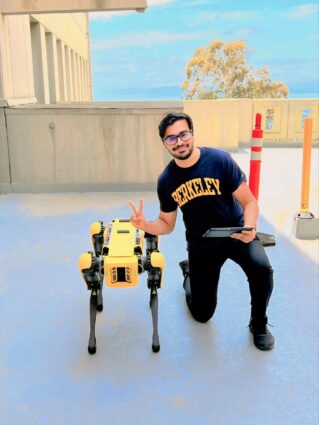
Claire chatted to Kushant Patel from Brookhaven National Laboratory about robots that work in scientific facilities, such as particle accelerators. Kushant Patel builds software that helps robots and instruments perceive, map, and move through the physical world. After completing a Master’s in Mechatronics Engineering at the University of Waterloo, he spent two years at the University

on October 8, 2026 at 8:20 pm
Smartphones combine cameras, motion sensors and powerful processors in devices that fit inside a pocket. These features could also make them useful components for robots, reducing the need to buy and connect separate sensors, processors or other electronics.

on October 8, 2026 at 11:00 am
Labor shortages, supply-chain volatility and growing demand for customized products are forcing a fundamental rethink of how work gets done in U.S. manufacturing. To remain competitive, manufacturers must produce increasingly complex parts with fewer workers, shorter lead times and greater flexibility than ever before.

on October 7, 2026 at 6:00 pm
Researchers have created an aquatic soft robot inspired by marine invertebrates called feather stars. The feather star robot is able to move through the water in all three dimensions, powered by only two actuators. The paper, “Minimal-Actuation Feather Star–Inspired Soft Swimmers for Multimodal 3D Maneuverability,” is published in the journal Science Advances.